Health and Safety Policy for Commercial Waste Removal Hackbridge
 This Health and Safety Policy sets out the principles and procedures that govern safe operations for Commercial Waste Removal Hackbridge and related commercial rubbish services. It applies to all staff, subcontractors and third parties engaged in commercial waste collection and disposal across our service area. The policy is designed to ensure that waste removal activities are conducted without risking the health and safety of employees, clients, or the public.
All personnel must understand their duties and the standard operating expectations. The policy emphasises a proactive approach to risk reduction through competent supervision, thorough training and clear allocation of responsibilities. The document uses the term rubbish removal in Hackbridge as a descriptive service area reference while maintaining a focus on operational safety and statutory compliance.
 The organisation recognises its legal and moral responsibilities and will: assess hazards, implement control measures, and maintain records. Every project — from commercial waste collection Hackbridge to on-site removal of bulky commercial items — shall be preceded by a site-specific risk assessment that identifies manual handling, traffic management, sharps and hazardous waste risks.
Responsibilities are allocated as follows: senior management will provide leadership and resources; supervisors will ensure compliance with procedures; and employees must follow safe systems of work. Training requirements include safe manual handling, use of mechanical aids, correct PPE usage and awareness of hazardous substances. All staff must report near misses and hazards so the organisation can act to prevent recurrence.
Personal protective equipment is mandatory where risk assessments identify a need. Protective gloves, hi-vis clothing, safety footwear and eye protection are standard items for day-to-day rubbish clearance tasks. For specific waste types, additional measures such as chemical suits or respiratory protection will be provided and maintained.
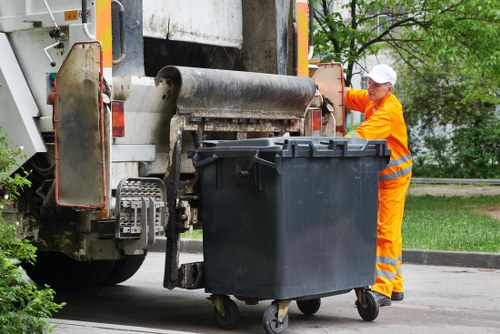
 Vehicles and plant used in commercial rubbish clearance are subject to routine checks and maintenance to ensure roadworthiness and operational safety. Drivers and operators must be trained and competent in loading, securing loads, and operating tail-lifts or compactors. A vehicle-specific checklist will be completed before each shift and defects reported immediately.
Hazardous and controlled wastes are handled according to regulatory requirements. The policy prohibits unsafe segregation and requires identification, containment and documentation of hazardous streams. Licensed disposal routes and authorised carriers are used for asbestos, sharps, contaminated liquids and similar materials to avoid environmental contamination and worker exposure.
Emergency response provisions include clear procedures for spills, sharps injuries, fire incidents and first aid. The organisation will maintain trained first aiders, spill kits, and incident escalation protocols. Records of incidents and corrective actions will be retained to support continual improvement of the waste removal service and safety systems.
Training and competence development are ongoing. Induction training covers the company's safety arrangements and expectations for anyone involved in commercial waste removal. Further training addresses specific tasks such as the operation of compaction equipment, safe lifting techniques, and hazardous waste handling to ensure that personnel are confident and competent.
Monitoring and review are central to this policy. Routine audits, toolbox talks and safety inspections will assess adherence to safe working practices. Performance indicators such as incident frequency, near-miss reports and audit findings will inform management reviews and resource allocation to improve safety outcomes across waste removal services.
 Contractors and subcontractors engaged for commercial rubbish clearance must comply with the same high standards and provide evidence of adequate insurance, training and safe working practices. A permit-to-work or site induction process will be used where required to align external teams with in-house safety procedures.
 Records, documentation and retention of training logs, risk assessments, maintenance checks and incident reports will be managed systematically. The policy will be reviewed at least annually and revised following significant incidents, organisational changes or legislative updates. Management is committed to providing the resources necessary to implement and sustain these safety arrangements for all waste removal operations.
Key Elements
Core duties and continuous improvement
- Risk assessment and control – identify and mitigate risks for each commercial waste task.
- PPE and training – ensure correct equipment and instruction for all staff.
- Vehicle and plant safety – maintain and inspect to reduce mechanical risk.
- Hazardous waste management – follow approved containment and disposal routes.
- Incident response – immediate action, investigation and corrective measures.
Conclusion: This Health and Safety Policy supports the safe delivery of commercial waste removal services across our service area. It balances practical operational controls with a commitment to continuous improvement and regulatory compliance. All employees and partners are expected to act in accordance with this policy to protect health, safety and the environment while delivering professional waste removal and rubbish clearance services.